Beyond Cappuccinos and Cobblestones
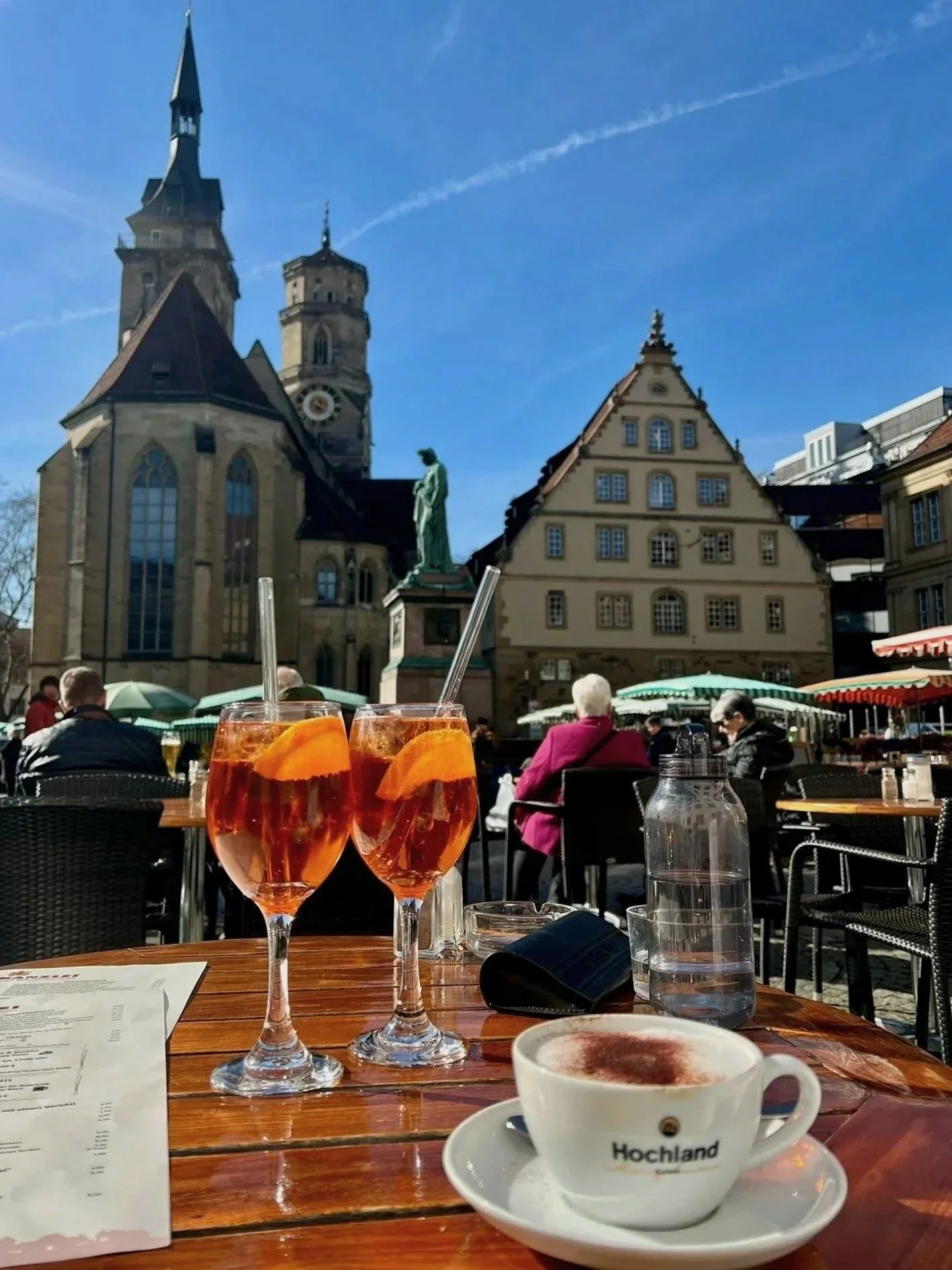
Yesterday, the forecast promised 18 degrees Celsius in February—the first warm day of the year. I met my friend Valeria to mark its arrival, which for us means choosing a place where light and space matter, feeling the warmth on our skin, and talking about politics and the world. Floral stands dotted the square. People lifted their faces toward the late morning sun . The church silhouette cut cleanly into the blue sky. Cobblestones marked the square, grounding the scene and giving it weight.
That coherence is what fascinates me. Not the flowers as objects. Not the church as an image. The way the square gathered people into a shared tempo. Conversations slowed. Laughter carried differently. The space drew out a version of us that felt more attentive, more permeable—lighter.
Later, I stopped at my favorite café, Gottlieb, and ran into an acquaintance who was unexpectedly delighted to hear about my blog. He mentioned that he once ran one on aesthetic dimensions and asked a question that has stayed with me: what do people actually do with aesthetics, like what is their contribution to the world?
The Work of Aesthetics
The question lingered, and I began thinking of objects. Interiors. Design choices. Coffee packaged in minimalist designer bags, described with sensory precision—notes of citrus and jasmine, hints of blueberry and strawberry jam, floral complexity, traces of dark chocolate and subtle spice. Do people drink it and mistake these descriptions for meaning? Do they sit in carefully composed rooms and confuse ambience with insight? Is attention to such details merely a refined form of showing off: I drink this coffee, therefore I am?
There is a discomfort that lies within these questions. Caring about space can easily slide into curating a personality. The cappuccino becomes a credential. Minimalist cutlery reads as moral position. Taste masquerades as depth. The suspicion of aesthetic snobbery has its reasons. Objects circulate as status signals. Design carries economic and cultural codes that not everyone shares. Yet reducing aesthetic experience to social signaling misses something essential.
When we speak of aesthetic experience seriously, we enter a philosophical lineage. Hermann Schmitz described atmospheres as spatially extended feelings—something that occupies space and takes hold of those within it. Gernot Böhme refined this idea, arguing that atmospheres tune us, like instruments that must be calibrated before producing coherent sound. Their shared claim is radical: atmosphere is not decoration. It is a condition of experience.
Atmosphere as the Ground of Experience
This is not abstract theory floating above daily life. It is observable. Enter a room with harsh lighting and metallic echoes, and your body tightens. Sit in a space where light moves gradually across textured surfaces, and your breathing shifts, your voice lowers, your thoughts lengthen. The environment shapes you before you even notice.
Artists and architects have harnessed this deliberately. Tadao Ando (1941) builds with concrete and light to generate silence as a spatial quality. And Peter Brook (1925–2022) as one of the clearest examples of this principle in practice. Brook avoided artificial staging and spectacle, focusing instead on the power of presence in an empty room. In The Empty Space (1968), he writes:
“I can take any empty space and call it a bare stage. A man walks across that stage while someone else watches him, and that is all that is needed for an act of theatre to be engaged.”
Brook’s International Centre for Theatre Research put these ideas into action, often using bare stages or minimal environments to focus on the interplay between actors, audience, and the surrounding space. The effect was not decorative, but transformative: the empty room amplified attention, presence, and shared experience. In productions like his Royal Shakespeare Company Midsummer Night’s Dream (1970), stripped-down platforms and open expanses allowed audiences to fill in the imagination themselves. The theatre did not show—it evoked.
Peter Brook’s insistence on avoiding “deadly theatre”—productions weighed down by cliché, illusion, or distraction—mirrors the argument here: aesthetic awareness is not about accumulation or status. It is about creating conditions that shape perception, attention, and even human behavior in subtle, profound ways. The lesson from Brook is that the power of a space lies not in what it displays, but in how it aligns with the humans within it.
Atmospheres shape us before we even reflect. Light, acoustics, and material presence alter the nervous system. That subtle regulation guides attention, and attention shapes thought. A chaotic environment fragments perception; a coherent one allows associations to deepen. This affects how we speak, how we listen, how we make decisions.
They also influence who we become in a given space. We do not behave the same everywhere. In some spaces, efficiency dominates; in others, reflection or intimacy surfaces. The square yesterday, with its flower stands and collective tilt toward the sun, invited ease. The café later carried a denser, more focused tempo. These shifts are not trivial. Over time, the spaces we inhabit train our sensibilities, recalibrating thresholds for beauty, patience, and irritation.
Aesthetic Snobbery and the Work of Perception
There is, of course, a risk of mistaking this for lifestyle signaling. Certain lifestyle-associated objects carry high price tags. Certain interiors convey cultural literacy. Possession can easily be confused with depth, and the critique of aesthetic snobbery exists for a reason.
My friend Nihan always encourages me to write longer pieces, to avoid compressing reflections into fragments that end too quickly, leaving the reader wondering: Why is there no more? She is right. Experience is not a slogan. It unfolds over time: in how a conversation deepens, in how a space accommodates silence, in how a season announces itself through subtle shifts in air and color. I aim to expand my thoughts so that the reader experiences a widening of perception rather than a constriction of insight. I believe it is precisely those with a slightly depressive attentiveness who are able to notice and register such subtleties.
So what do people do with aesthetics? What is their contribution to the world? Some may use it to signal belonging. Some may use it to elevate themselves socially. Another possibility, more demanding, is to refine perception: to create conditions in which awareness intensifies, to inhabit spaces that support the version of themselves they wish to cultivate.
Yesterday’s lounging at the square mattered not because it was picturesque, but because outer arrangement and inner experience aligned. The space gathered us, steadied us, stretched time just enough for the seasonal shift to register as shared. It was a place we wished we could linger in longer. Returning to my acquaintance’s question, one answer is that people use aesthetics to tune themselves.
Aesthetic experience, taken seriously, is not proof of superiority. It is a medium of formation. It is far more interesting than shallow performances of taste, far more consequential than quiet competitions over who owns the right objects. The real question is not whether someone looks sophisticated holding a cup of Ethiopian coffee, but whether the space in which they drink it enlarges their capacity to perceive, to think, and to relate.
It does not ask for certificates or recognition. It asks for presence, for patience, for the willingness to be altered by something as simple—and as complex—as a square of sunlight on cobblestones. Everything else, every carefully curated object, is incidental. What matters is whether the experience reaches you, leaves you slightly, indelibly changed, and whether its reward is nothing less than the way it changes those who notice it.