
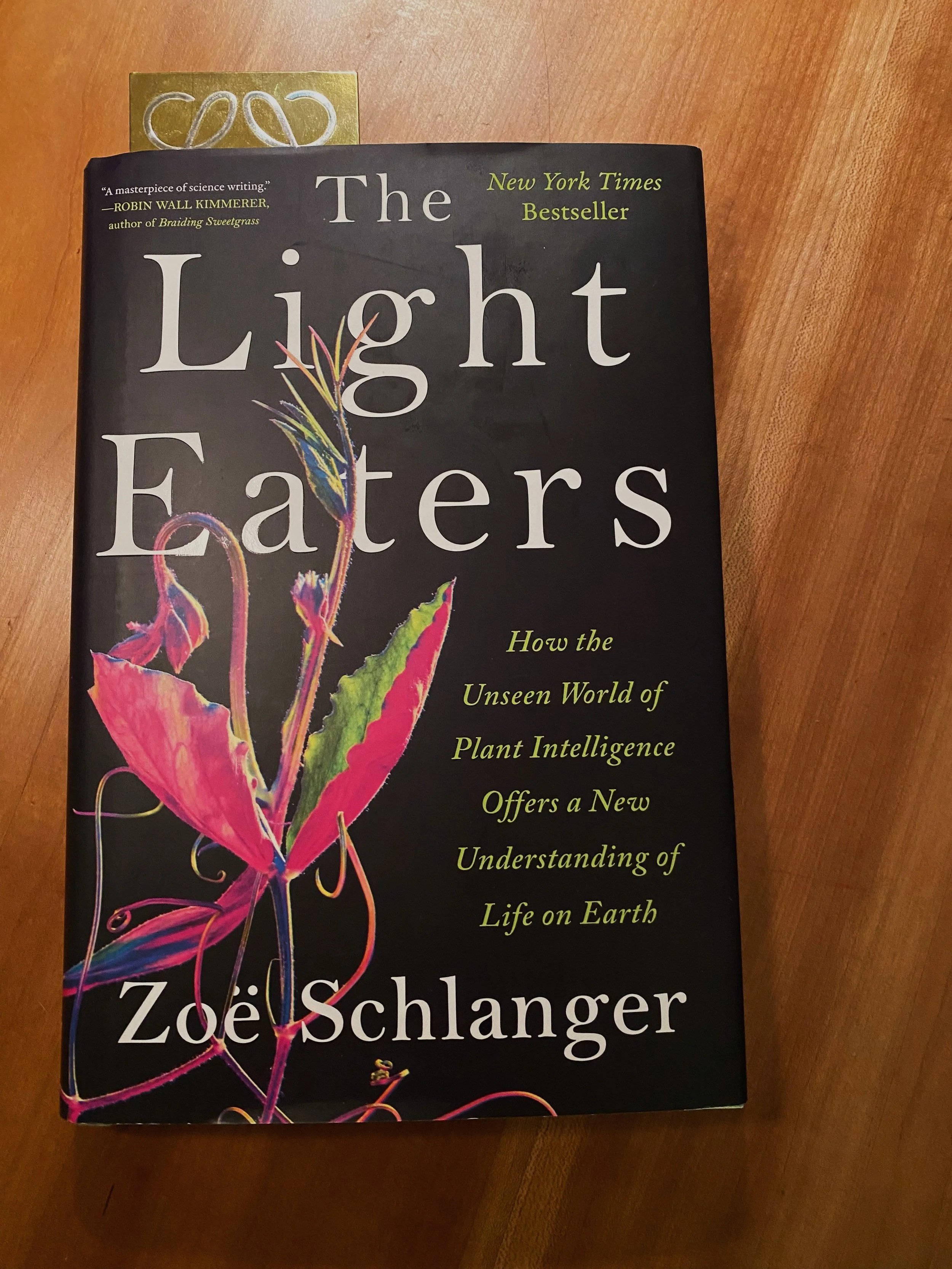
Every plant has a story, and suddenly you start seeing it. This book shifts something fundamental in the way you see the world.
Delhi Diva
The Light Eaters opens up a world that is largely outside our perception. Plants sense every change in light, temperature, pressure and humidity. They respond to chemicals released by neighboring plants, alter their growth in response to their surroundings, and send signals through roots and fungal networks beneath the soil. What looks static from our perspective is filled with activity
The further you get into the book, the more expansive this idea becomes. Plants retain forms of memory. They distinguish between different kinds of stimuli. They change their behavior according to previous experience. They compete, cooperate, defend themselves and adjust to the organisms around them. Their lives unfold at a different pace and through a sensory world that is largely inaccessible to us. We have spent so much time equating movement with activity that we have overlooked what is taking place in forms of life that remain rooted in one place.
One of the book’s most profound insights is that our perception of the world is not the world itself. What we cannot see, hear or experience does not become less real because our senses cannot register it. Plants detect signals we barely notice and respond to environmental changes long before we would recognize them as events. Their lack of visible movement tells us very little about the complexity of their lives.
That shifts the way familiar places begin to feel. A forest becomes more than a collection of trees. Soil becomes a dense, active environment. A garden becomes a network of exchanges between plants, fungi, insects, microorganisms, water, light and air. Even a houseplant begins to occupy a different place in your awareness.
What makes Zoë Schlanger’s book so compelling is that she does not ask us to imagine that plants are somehow “like us.” Instead, she asks a much more interesting question: what if intelligence does not need to resemble our own? We tend to associate intelligence with a brain, a nervous system, movement, memory and individual decision-making. Plants have none of these in the human sense, yet they perceive their surroundings with remarkable sensitivity and respond to what they encounter.
The Light Eaters never needs to turn plants into miniature versions of ourselves to make them fascinating. Its deeper argument is more radical: perhaps we have been using a definition of intelligence that is far too narrow. Perception, memory, responsiveness and communication can take forms that have no brain, no voice and no recognizable center.
I was especially struck by the book’s challenge to our idea of the individual. Plant life is profoundly relational. Roots, fungi, microbes, insects and neighboring plants participate in systems of exchange that make the boundaries between organisms far less clear-cut than they appear from our perspective. Intelligence starts to look less like something contained within a single mind and more like something that can emerge through an organism’s relationship with its surroundings.
After reading it, plants no longer look as passive as they once did. They still appear to be still. They still make no obvious sound. But beneath it is a world of signals, responses, adaptation and exchange unfolding on timescales and through sensory systems that we rarely perceive.
Some books give you information. Others alter the frame through which you see something familiar. The Light Eaters belongs to the second category. It stayed with me long after I finished it because it made the living world feel larger, more complex and far less familiar than I had assumed.
From time to time, I’ll share books that remain with me long after the last page. This is one of them.